Every credit card statement in India shows two numbers side by side: the Total Amount Due and the Minimum Amount Due. Paying the smaller number feels harmless — the account stays active, no late fee shows up, and your credit score looks fine for another month. But that small payment can quietly turn a manageable bill into a debt that takes years to clear. Here's how the minimum due is actually calculated, what interest rates banks in India charge, and why the gap between "minimum due" and "total due" is one of the most expensive gaps in personal finance.
What Is the Minimum Amount Due?
The Minimum Amount Due (MAD) is the smallest sum you must pay by the due date to keep your card account in good standing and avoid a late-payment fee. It is not a discount on your bill — it is simply the threshold below which the bank treats you as delinquent. Everything you don't pay continues to sit on the card as an outstanding balance, and that balance starts attracting interest immediately.
Paying the minimum due protects two things:
- Your credit score, since a missed minimum payment is reported to credit bureaus
- Your account status, since it avoids late-payment penalty fees
It does not protect you from interest. Interest keeps accruing on the unpaid balance regardless of whether you paid the minimum.
How Is the Minimum Due Calculated?
Since December 2022, the Reserve Bank of India requires every card issuer to use a standard formula rather than an arbitrary flat percentage. In practice, most banks calculate MAD as the higher of:
- 100% of the interest, fees, and applicable GST billed in that cycle, or
- Roughly 5% of the total outstanding balance
To this base amount, banks typically add:
- Any EMI instalment due that cycle (if you've converted a purchase to EMI, the full instalment must be paid — it's never part of the "minimum")
- Any overlimit amount
- Any unpaid balance carried over from a previous cycle
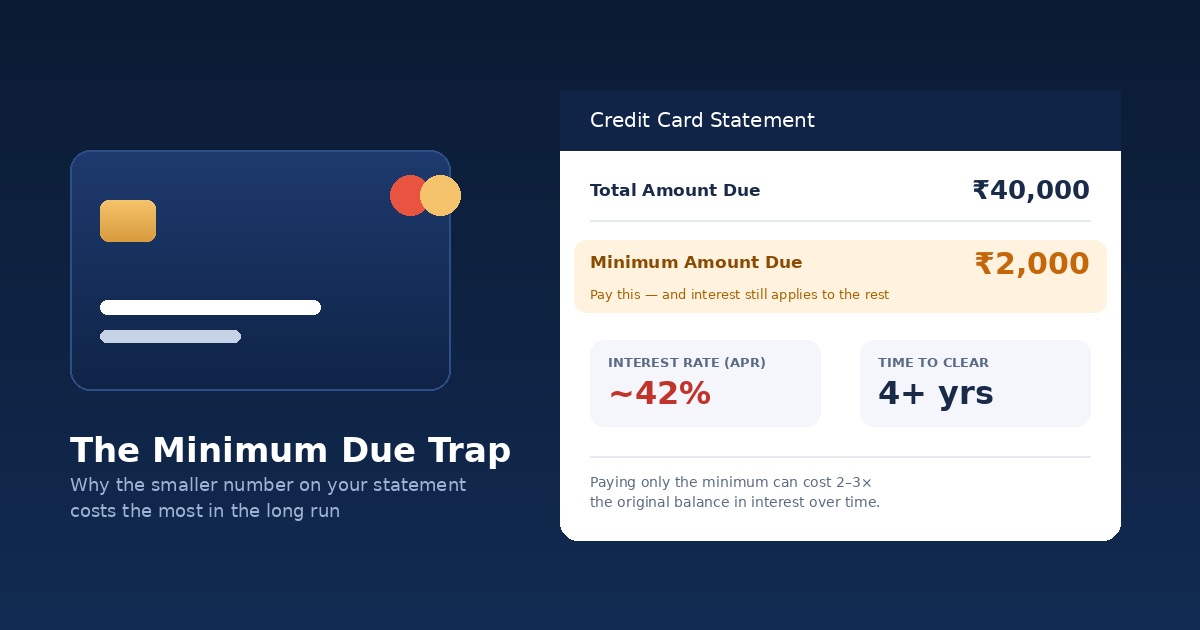
Example: Say your total outstanding is ₹40,000, and ₹1,200 of that is interest and fees from this cycle. Since 5% of ₹40,000 (₹2,000) is higher than ₹1,200, your minimum due would be ₹2,000 — plus any EMI instalments or past dues on top of that. Want to see this worked out for your own bill? Try our EMI calculator to compare what converting a balance to EMI would actually cost versus letting it revolve.
A few banks, including SBI, have widened this formula further in the last year to also fold in 100% of finance charges and GST rather than just a flat percentage, which has pushed minimum-due amounts higher than what cardholders were used to seeing. The exact formula can vary slightly by issuer, so always check the fine print on your own statement — it's usually explained on the back page or in the Most Important Terms and Conditions (MITC) document.
Credit Card Interest Rates in India: Bank-Wise Comparison
Credit card interest (also called the "finance charge") in India is charged monthly but usually quoted as a monthly percentage, which compounds into a steep annual rate. As of 2026, typical ranges look like this:
| Bank | Monthly Interest Rate | Approx. Annual Rate |
|---|---|---|
| HDFC Bank | Up to ~3.4% | Up to ~41% |
| ICICI Bank | ~2.49% – 3.75% | ~30% – 45% |
| SBI Card | ~1.99% – 3.6% | ~24% – 43% |
| Axis Bank | ~1.5% – 3.6% | ~18% – 43% |
| Kotak Mahindra Bank | ~2.49% – 3.7% | ~30% – 44% |
Across the industry, the broad range quoted by most banks and comparison platforms is 2.5% to 3.75% per month, or roughly 30% to 45% annually — among the highest interest rates of any mainstream retail credit product in India, well above personal loan or even most gold loan rates.
Rates vary by card variant, your relationship with the bank, and can change at the issuer's discretion — always confirm the exact rate on your current statement rather than relying on published ranges.
A Few Things That Make the Real Cost Higher Than It Looks
- No grace period once you're carrying a balance. If you pay your bill in full every cycle, most cards give you an interest-free period of 18–50 days from the transaction date. But the moment you carry forward even a partial balance, that grace period disappears — interest is charged from the original transaction date, not just on the unpaid portion.
- GST is added on top. 18% GST applies to the interest and finance charges themselves, not just to fees — a detail that's easy to miss when estimating what you owe.
- Cash withdrawals are worse. ATM cash withdrawals on a credit card attract interest from day one, with no interest-free period at all, often at the higher end of the bank's rate range.
Why Paying Only the Minimum Due Can Turn Into a Debt Trap
Because the minimum due shrinks as your balance shrinks, and interest keeps compounding on what's left, paying only the minimum stretches repayment out far longer than most people expect — commonly years rather than months for a moderate balance. Depending on the balance, the rate, and how consistently only the minimum is paid, the total amount eventually paid back can run to two or three times the original bill.
Here's a simplified illustration at a typical monthly rate of 3.5% (about 42% annually):
| Outstanding Balance | Paying Only Minimum (~5%) | Approx. Time to Clear | Approx. Total Interest Paid |
|---|---|---|---|
| ₹20,000 | ~₹1,000/month, reducing | 3–4+ years | Often exceeds ₹20,000 |
| ₹50,000 | ~₹2,500/month, reducing | 4–5+ years | Can exceed ₹50,000 |
The exact numbers depend on your card's specific rate, fees, and how your balance changes month to month — but the pattern holds across virtually every Indian card issuer: the minimum due is designed to keep the account active, not to help you get out of debt quickly.
How to Avoid the Minimum-Due Trap
- Pay the full statement balance whenever possible. This is the only way to avoid interest entirely and keep your interest-free period intact next cycle.
- If you can't pay in full, pay as much above the minimum as you can. Even an extra ₹500–₹1,000 a month meaningfully cuts down the total interest and the payoff timeline.
- Consider converting a large one-time purchase to EMI rather than letting it sit as revolving debt — EMI interest rates are usually lower than the card's standard revolving rate. Run the numbers with our EMI calculator before you decide.
- Avoid credit card cash withdrawals except as a last resort, since there's no interest-free period on them.
- Track your due date and set autopay for at least the minimum due, so a missed payment never becomes a bigger problem than the interest itself. A strong credit history also affects the rates you're offered elsewhere — see how CIBIL and interest rates connect in our home loan tips guide.
- If your outstanding balance has become genuinely unmanageable, most banks offer structured EMI conversion or debt consolidation options — it's worth calling the bank directly rather than continuing to roll over the minimum indefinitely.
The Bottom Line
The minimum amount due exists to keep your account technically current — not to save you money. With Indian credit card interest rates commonly running 30–45% annually, and interest applying from the transaction date the moment a balance is carried forward, the gap between paying the minimum and paying in full is one of the most expensive decisions a cardholder can make without realizing it. Treat the "Total Amount Due" as the number that matters, and the "Minimum Amount Due" as an emergency fallback — not a monthly plan.
This article is for general informational purposes and does not constitute financial advice. Interest rates, fees, and minimum-due formulas vary by bank and card variant and are subject to change — always refer to your own card's Most Important Terms and Conditions (MITC) document or current statement for exact figures.